




By Lian Cheng & Yvonne Tuah
KUCHING, Aug 25: Sarawak today stands in stark contrast to what it was eight years ago. There is a marked change in the air with new buildings, expanded road networks, and ongoing infrastructure projects that promise improved accessibility and a broader spectrum of opportunities. The visible progress mirrors the substantial economic growth Sarawak has experienced under the leadership of its Premier, Datuk Patinggi Tan Sri Abang Johari Tun Openg over the past eight years.
High Income State

With Abang Johari at the helm, Sarawak has ascended to new heights, achieving high-income status under the World Bank’s 2022-2023 classification, despite the temporary hiccup caused by Covid-19 between 2020 to 2021.
In 2023, Sarawak’s momentum continued, with its Gross National Income (GNI) per capita reaching a commendable USD16,560 (approximately RM77,968). This remarkable feat prompted World Bank lead economist for Malaysia, Dr Apurva Sanghi, to observe that Sarawak is among the five states in Malaysia that have achieved high-income status, he said in a post on X. Sarawak’s sustained economic growth is also evident in its consistent gross domestic product (GDP) performance and its resilience in rebounding from the initial impact of the Covid-19 pandemic.
In 2021, according to the Department of Statistics Malaysia (DOSM), Sarawak’s GDP in 2021 rose to 2.9 per cent from a decline of 6.8 per cent in 2020, reaching an economic value of RM131.2 billion compared to RM127.5 billion in 2020. Sarawak continued to track positive growth in 2022 to 2023, with its GDP rising by 6.5 per cent, and an economic value of RM140.2 million in 2022, followed by another 1.2 per cent in 2023 to an economic value of RM142.4 billion.
Looking ahead to 2024 and 2025, Abang Johari projected that Sarawak’s GDP would expand by five to six per cent, supported by strong external demand, increased domestic activity, and easing inflationary pressures.
Upholding a Legacy
But Sarawak’s rise to its current level of success has not been without challenges. Succeeding former Chief Minister Pehin Sri Adenan Satem in 2017, Abang Johari had big shoes to fill, tasked with fulfilling Adenan’s legacy of prioritising Sarawak’s interest above all else while also navigating the political turbulence that swept the nation in the year that followed.
Following the historic fall of the Barisan Nasional (BN) coalition in 2018, Abang Johari demonstrated firm leadership by uniting Sarawak’s political parties under the Gabungan Parti Sarawak (GPS) banner; a move which ensured a stable political landscape for the State, providing the foundation needed to advance major infrastructure projects and attract investments into the region. During his first year in the office, Abang Johari, who was then still Chief Minister of Sarawak, tabled a landmark Sarawak budget of RM5.78 billion against an expected revenue of RM5.53 billion, resulting in a projected deficit of RM256 million.
He explained that Sarawak’s revenue had been on a downward trend since 2015, largely due to falling oil and gas prices, reduced returns from the forestry sector, and rising expenditure commitments. Like previous Sarawak budgets, Abang Johari’s first budget was development-focused, with a significant portion allocated to rural infrastructure, including road upgrades, water supply, electricity coverage, and various initiatives aimed at improving the welfare and economic prospects of rural communities.
What made this budget particularly significant was the allocation of RM1 billion specifically for enhancing digital infrastructure and connectivity, while also nurturing a new, IT-literate generation. His vision for 2018 was clear: to position the digital economy as the central pillar of Sarawak’s future economic growth.
Bold Budgets for a New Tomorrow

Later that year, in a bold move on November 5, 2018, Abang Johari unveiled the largest-ever Sarawak Budget of RM11.914 billion for 2019. With a substantial RM9.073 billion earmarked for development, the budget not only surprised Sarawakians but also instilled a renewed sense of hope for the State’s future. Sarawak has long been a State blessed with abundant natural resources, yet for years it was neglected and remained one of the poorest states in Malaysia.
This unprecedented budget, with its significant allocations for infrastructure development, education, and healthcare, signalled a strong commitment to addressing the historical disparities that had long held Sarawak back. Sarawakians, who had for decades felt marginalised despite their resource-rich land, were now witnessing tangible progress towards greater inclusivity. Major investments in rural development and emphasis on building a more sustainable economy, through initiatives such as the expansion of digital infrastructure, further strengthened the belief that Sarawak could finally unlock its full potential and secure a brighter, more equitable future for its people.
In the following year, Abang Johari sustained this momentum by introducing another record-breaking budget of RM13.357 billion for 2020. A significant portion of this budget, RM6.597 billion, or 49 per cent, was allocated for development expenditure, with a particular focus on accelerating rural development. The remaining RM3.294 billion was set aside for operating expenditure.
Rising Above the Covid-19 Tide
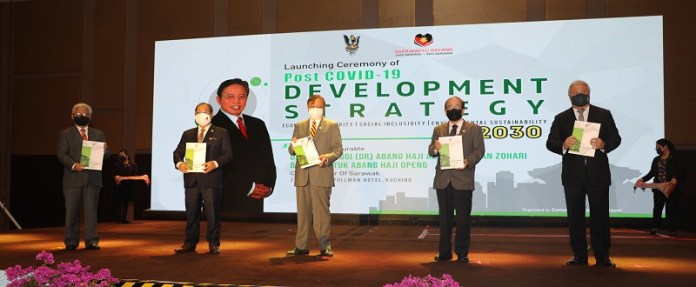
Sarawak’s economic acceleration, however, came to a halt in 2020, hindered by imposed lockdowns and widespread disruptions brought on by the Covid-19 pandemic. Nevertheless, Abang Johari announced a RM10.012 billion budget for 2021, with an expected surplus of RM180 million, expressing full confidence that Sarawak could weather the challenges.
At the same time, he introduced the Post Covid-19 Development Strategy 2030 (PCDS 2030), a comprehensive long-term plan to reinvigorate Sarawak’s economy.
Under the shadow of the Covid-19 pandemic and with authority vested under Section 11 of the Emergency (Essential Powers) (Sarawak) Ordinance 2021, Abang Johari presented a RM10.136 billion budget for 2022 during a Special Budget Meeting. Unlike past budgets that prioritised large-scale infrastructure projects, the 2022 Budget shifted focus towards providing critical support for the people and the economy, as the Sarawak Government continued to navigate the challenges brought by the pandemic.
With an estimated total revenue of RM10.036 billion, Abang Johari disclosed that RM4.907 billion, or 49 per cent, was derived from tax revenue. This included RM3.162 billion generated through the State Sales Tax (SST) on crude oil, liquefied natural gas, and other petroleum products.
Abang Johari’s steadfast commitment to PCDS 2030 began to bear fruit in 2023, as Sarawak’s economy showed signs of recovery.
Steering Sarawak Back on Course
With revenue projected to reach RM11.035 billion, a RM10.797 billion budget was announced for 2023. The bulk of the revenue (48 per cent or RM5.246 billion) was expected to be derived from taxes, royalties, premiums, tariffs, and land rentals, while RM5.498 billion was expected to come from non-tax revenue. The following year, Abang Johari further built on this momentum by unveiling a record-breaking RM12.36 billion budget for 2024, with 66 per cent (RM9.04 billion) earmarked for development purposes and RM4.56 billion allocated for operating expenditure.
It was his hope that high allocations towards infrastructural projects and people-centric programmes would spur economic growth, particularly among rural communities, and enhance the overall quality of life for the people. Since introducing a budget of RM13.357 billion in 2020, and consistently tabling budgets exceeding RM10 billion from 2021 to 2023, followed by a substantial RM12.36 billion budget for 2024, Sarawak’s economic landscape has undergone a significant transformation. In just five years, Abang Johari has propelled Sarawak to new heights, solidifying his reputation as an effective business leader and the architect of a new Sarawak.
Yet, he is not one to rest on his laurels. In 2024, he raised the bar even further by unveiling a record-high RM15.8 billion budget for 2025, expected to be sustained through multiple revenue streams, including taxes, non-tax revenue, non-revenue receipts, grants, and reimbursements from the federal government. The imposition of State Sales Tax (SST) and production-sharing contracts managed by Sarawak Petroleum Berhad (PETROS) in collaboration with Petroliam Nasional Berhad (PETRONAS) and other partners are also expected to be among the largest contributors to Sarawak’s expanding income.
Furthermore, ongoing urbanisation initiatives and expanding infrastructure development across Sarawak have significantly increased revenue from real estate and property development.
“This budget reflects Sarawak’s successful revenue engineering strategies and prudent financial management.
“The Budget will continue to be expansionary to boost government spending that will further stimulate the State’s economic growth, while making substantial investments in infrastructure and placing the well-being of the rakyat at the forefront of our priorities,” he said when tabling the budget during the Sarawak Legislative Assembly sitting on November 11, 2024.
A Testament to Vision and Prudence

Years of prudent economic management, including expansionary budgets and carefully implemented strategies, culminated in Sarawak achieving a record-high revenue of RM14.8 billion in 2024. Since 2017, under Abang Johari’s stewardship, the Sarawak government has invested nearly RM40 billion in strategic development initiatives aimed at propelling the State towards its goal of becoming a developed, high-income economy by 2030.
Among the key milestones was the acquisition of the Bakun Hydroelectric Power (HEP) Dam from the Federal government for RM2.5 billion, in addition to servicing RM5.6 billion in outstanding loans. Other major initiatives include RM5.1 billion for water and electricity supply improvements; RM2.25 billion for communications infrastructure; RM6 billion for the Kuching Urban Transportation System (KUTS), which will introduce hydrogen-powered Autonomous Rapid Transit (ART) vehicles; and RM11 billion for the construction of coastal highways, including eight major bridges.
To ensure inclusive development across all regions, the Sarawak government also allocated RM1.5 billion to each of the nine Regional Corridor Development Authority (Recoda) agencies, namely the Ulu Rajang Development Agency (URDA), Highland Development Agency (HDA), North Region Development Agency (NRDA), Sri Aman Development Agency (SADA), Integrated Regional Samarahan Development Agency (IRSDA), Betong Division Development Agency (BDDA), Rajang Delta Development Agency (RADDA), Mid-Rajang Development Agency (MiRRDA)—formerly known as the Rascom Development Agency (RASDA), and the Greater Kuching Coordinated Development Agency (GKCDA).
In total, the Sarawak government has committed a staggering RM39.95 billion to development initiatives—an amount that excludes two major acquisitions: MASwings and Affin Bank. These development investments, supported by multifaceted income streams such as the SST on oil and gas products, are expected to yield significant returns by stimulating economic growth and positioning Sarawak as an increasingly attractive destination for both domestic and international investors.
A Vital Cog in National Economy
Throughout 2024, Sarawak had successfully attracted investments totalling RM17.6 billion across 376 projects, with the potential to create approximately 7,800 new job opportunities. During the Sarawak Legislative Assembly in May 2025, Sarawak’s Minister of International Trade, Industry and Investment Datuk Amar Awang Tengah Ali Hasan said the approved investments spanned across the services, manufacturing and primary sectors, with Domestic Direct Investment leading at RM13.5 billion or 76.6 per cent, while Foreign Direct Investment contributed RM4.1 billion or 23.4 per cent.
A total of 115 manufacturing and related services projects were also approved in 2024, with over 65 per cent successfully implemented. Between 2019 and 2023, the Sarawak government approved RM31.8 billion in FDI for high-tech industries, with a particular focus on the electrical and electronics, chemical, and green metals sectors. Sarawak kicked off 2025 on a strong economic footing, with the manufacturing sector securing RM681 million in approved investments across 24 projects during the first quarter. These investments are expected to generate over 900 job opportunities.
Key areas of focus include the electrical and electronics sector, which attracted RM75 million in investments, the manufacturing-related services segment, particularly warehousing, which secured RM20 million; and the non-metallic mineral products sector, which drew RM16 million in investments.
From an economy once heavily reliant on agriculture and mineral extraction, Sarawak has come a long way. Under the forward-thinking leadership of Abang Johari, whose visionary ideas aim to position Sarawak on the global map, the State has emerged as a formidable economic force. Today, Sarawak stands as a vital cog in Malaysia’s economic engine, contributing significantly to the nation’s overall growth and development. – DayakDaily